Showing posts with label australorp. Show all posts

29 March 2012

My Gentle Giant

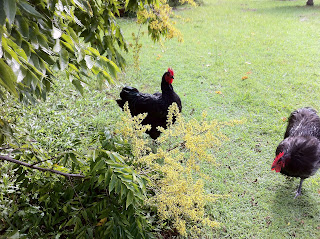
Everyone who meets my beautiful Australorp Rooster, Chop-Chop comments on how big he is. Some people tend to find his size intimidating, but he is such a tame, gentle baby despite his size.

I introduced him to my daughter, Hannah yesterday. The last time she saw him, Choppy and his hatch mates were only about 8 weeks old and quite a lot smaller than they are now.

Choppy, always being interested in something nice to eat, came running down to greet us when he heard our voices in the yard.

Tearing up to us at full pelt, I guess he was a bit of a formidable sight! Hannah squeaked in alarm and stepped backwards, holding out her hands to ward him off, and Chop Chop stopped in his tracks clucking his confusion at this strange reaction.

I encouraged Hannah (who is 23) not to be afraid and that Choppy is just a big sook.

After a few nervous moments observing him and being reassured that he would not attack her, Hannah fed him some wild corn, which he picked, delicately from the palm of her hand, amazing her with his gentleness.


He is a sweet natured boy and has never shown the slightest hint of aggression towards anyone.

Despite his formidable size, he truly is just a big old baby and I adore my gentle giant.


18 March 2012

Updates

Well, it has been more than a week since I posted about the rooster box that we set up for my beautiful big Australorp Cockerel, ChopChop. He's getting used to the routine of being put into his box each evening, and let out again in the morning. As far as crowing goes, I only hear him if I happen to be awake, so that means I have not heard him crowing before 8am since we put him into his box. He does crow while he is in there, but the sound is somewhat muffled. I have not heard from the neighbours about whether he is still waking them at 2am, so if I don't hear from them in the next few days, I will pay a visit and ask if all is well now. I'm hoping we've solved the problem.

Last Wednesday, I went broody and set 8 eggs to incubate in the el cheapo incubator I bought last year. I candled them at day 3 but the results were pretty inconclusive. I'm hoping that perhaps Boomer managed to fertilise some of the eggs before we sold him, and decided to set some to see if that's the case. It costs next to nothing to run the incubator and the eggs are a lot less precious and expensive than the previous batch I hatched. I'll keep the blog up to date. I think I might have just a couple that are viable. I will candle them again at day 7 and see how it looks.

Yesterday, I realised with horror that I have not wormed my flock since August last year! This could explain the unthriftiness in a couple of the birds and since the youngsters are now 6 months old, I decided I needed to get onto that asap. I gave the most unthrifty of the hens a dose of Moxidectin immediately, and this morning I put Piperazine into the drinking water for the rest of the flock, and wormed ChopChop with a couple of wormout pills. I am usually very careful to adhere to a three monthly worming system, but for some reason, time has slipped by while I was not paying attention. I will need to redo the whole flock in a fortnight to make sure that I have killed off all the possible worm burden from the birds.

We are once more up to our ankles in mud and water in the back yard, with three solid days of rain that has barely let up. I've given up trying to keep the chickens in out of the wet and have been letting them out to forage in the rain. They seem to have enough sense to get under cover if it really pelts down, and they spend a lot of time under the denser foliage of the mulberry trees when it's only light rain. They're getting a bit wet, but I have been locking them up early and feeding them oats to help them warm up so they are dry by the time they go up on the roost for the night.

There's not a lot going on other than these things. Life at Hensington Palace ticks by and everyone is relaxed and happy. After the 'interesting times' we had for the past few weeks, this is quite a refreshing break!

13 March 2012

Showing Poultry


I've been thinking about putting my Australorp pullet, "Chica" up on the show bench to get some feedback from a qualified judge about her type and form. It's a little daunting to think of this, but she is a very nice looking pullet and I feel she is quite close to the standard for Australorp hens.
Here is a photograph of "Chica" that I took yesterday. It is a little bit grainy as it was snapped through the livingroom window, which just goes to show how long it has been since I cleaned the windows! *blush* Please ignore my housekeeping and look at the fowl. :)
Chica
Of course, given that I hatched and raised this little girl by hand, I am possibly biased about her looks, although I am trying to look with clear eyes and put the rose coloured glasses aside.
The only real way to be sure, is to show her and find out.
Chica is 22 weeks old, not quite fully grown as yet, and still needs to feather out a bit more, but she has the shape of an Australorp to her and the lovely compact tail of her breed.
I've been doing some reading this morning on what it takes to prepare and train a young bird for show and I think I might begin prepping her at least. Getting her used to handling, and being penned in a small show box would be one way to start. I can also begin to condition her legs and comb and groom her feathers with a silk cloth. All of that will at least start to tame her down and get her used to being examined and judged.
The local "Agricultural Show" (similar to a county fair) is in June and I think I could have Chica tamed and trained in plenty of time for it.

12 March 2012

Rooster Boxes

I mentioned at the end of my previous post that my nextdoor neighbour had come over to my place on Saturday with an idea for a possible rooster box to put ChopChop our remaining rooster into at night time in an attempt to keep him quiet in the mornings. Not that Choppy crows all that much anyway, but I am interested in the idea of using a rooster box, both for now and for future roosters who may turn out to be just as dominant and noisy as ChopChop's brother, Boomer was.

The idea of a rooster night box, is to keep the bird in the dark until well past dawn and thus hopefully prevent him from crowing until a more reasonable time than say, 3am!

My neighbour came to ask me, initially, how to build the kind of box that I thought would work, but in the course of our discussion he had a brainwave. He hurried off back home to collect an item he had lying around in his garden shed to see if I thought it would be suitable.

The above picture is what he brought back. It is a collapsible canvas dog kennel for a small to medium dog, complete with a nice, soft cushion for the dog to sleep on. It is lying on its side in this image because it has a mesh bottom and we thought that would be good for airflow. The rooster could sleep inside this, with the cushion and some wood shavings underneath him for comfort and hygiene, and the mesh bottom could be faced toward the wall to allow air through without letting in too much light. I thought this was worth a try and R went back home to find something to use as a door for it.

The door is fashioned out of an old cargo pallet R had 'in the shed' as well.

R attached an aluminium bracket to the top of the wooden door.

The bracket neatly hooks over the metal framework and the bottom of the door
Pushes in flush against the front of the kennel.

The Rooster Box installed in the chicken coop ready for its occupant.

ChopChop checking out the new digs.

We have used this for three nights, so far, and it seems to work well, except for the second night when I had not quite blocked all light from getting into the box. Last night, I made a couple of tweaks to the coop area where the box is, and as far as I know, Choppy didn't crow at all. In fact, he has not crowed all day today. I wonder if he thinks being quiet means he won't need to go back into the box again?

So far, so good.

Next time: "Uh-oh, I'm broody again!"

05 March 2012

Interesting Times


Python approx 1.5m captured in our chicken coop

"May you live in interesting times."

The above is purported to be an ancient Chinese curse or proverb, and it has long been a favourite of mine, but recently, what with the soft-shell eggs problem, and the constant rain which is turning my garden into a mosquito and toad infested quagmire, I am beginning to understand why this simple phrase might be interpreted as a curse, regardless of where it originated.

According to the weather man a few nights ago, it is now officially Autumn in Australia. We should be seeing cooler weather (which we are) and the wet season should be coming to an end (which it's not!). We should be having cool, dry days but it has now been raining for three days without letting up and there are reports of road closures around our district due to flooding.

Added to that, last night when I put the chickens into their coops (they'd been out for forage while the rain was a little lighter), I noticed that the laying hens didn't go up to roost immediately. They spent a lot of time pecking and scratching around in their covered run, keeping to the front end of it. I didn't think too much of it, deciding they must simply feel like a bit extra to eat as the rain would have driven bugs and worms deeper into the ground.

I finished topping up feed hoppers and came down to the house, thoughts of my own dinner dancing around in my mind. I was getting ready to put dinner on when Sandra asked: 

"What on earth is going on with your chickens?"

Cocking my head to one side, I listened (I don't generally hear the chooks because I have come to tune them out as background noise). Sure enough, there was a ruckus coming from the direction of the coops. That is abnormal for chickens at nighttime so I knew something must be wrong. I took the torch (flashlight) Sandra had already grabbed and waded back out through the puddles and rain to the hen house.

All of the layer hens were in the front of their run, cackling, hooting and hollering at the top of their airsacs while their rooster was huddled in a wheezing heap in the corner. Nextdoor in the POL pen, the blue Australorp cockerel was hollering, hooting and swearing up a storm, too while his hens huddled in their roost making small, distressed cooing noises. Something was definitely amiss.

The blue cockerel was in danger of injuring himself trying to get through the wire to the laying pen, so I went to him first. I managed to herd him into the roost with his ladies after checking that all was well with them, and settled him down. 

Then I returned to the laying pen, with the blue cockerel calling out warnings to me from his hiding place all the while.

I went into the coop with the layers who immediately quieted down once I was on the scene. Shining my torch around, I slowly edged my way into the coop and shone the torch onto the roost...
And bolted with a shout that had every chicken on the property all hollering and flapping madly as well. I think I made it from the hen house, halfway to the patio before what I'd seen in the brief flash of the torch registered properly. I slowed my pace, took a breath and chided myself.

"That's just a carpet snake, dufus!"

Well, of course this creature would need to be evicted, and as far as I was concerned that was not a job for one person. I continued on my way down to the house and asked Sandra to come and assist with the removal.

We went back to the hen house, herded the laying hens and their wheezing guardian into another run and shut them in. Within seconds, hens and rooster had all piled onto the smaller, more cramped roost in the spare run, clucking and squawking like elderly tour bus patrons who were served cold tea on a rest stop and were determined to let 'management' know of their displeasure! "Just as soon as we've had a good lie down!"
 
Then commenced operation snake eviction!

I don't know if any of my readers have ever tried to catch a snake in a chicken coop before, but let me tell you, it's no easy feat! Those things are ​slippery!​ Not slimy, though, just really good at avoiding being hooked up with a garden fork. No matter how Sandra tried to get him off the roost and into a feed sack we'd brought up there for the purpose, the snake managed to slip, slide and slither away.

In the end, I grabbed him by his -- surprisngly muscular -- tail and hung on, trying to tug him out of the roost. The snake had other ideas. He got his head in behind a wooden beam and hooked himself up there and we got into a real tug-o-war! boy he was strong! I was worried about hurting him if I tugged too much, and Sandra suggested we might need to kill him to get him out of there.

Killing him was the last thing I wanted to do. Carpet Pythons are non-venomous and are handy for killing mice and rats around the sheds. Besides which, they are beautiful creatures and all this fellow wanted was a dry, dark place to coil up and sleep the rain away.

Deciding on a path of least resistance, I stepped forward, letting the tension off his body and the snake lost his grip on the beam and fell onto the soft straw bedding under the roost. I lost my grip on his tail at the same time and the chase was on again!

We managed with much shuffling, squealing (from me) and nervous sniping at each other, to get him from the coop into the run and finally, out of all patience with the ordeal I seized him by his tail again and hauled his scaly butt out into the rain!

Sandra brought the sack out of the chicken coop and we managed to finally bundle our captive into it. Now what to do with him?

It was decided that the best place for a rather war-weary python on such a rainy Sunday evening was a lovely heated reptilarium at Steve Irwin's Australia Zoo. The Zoo is, fortunately only a few kilometers from home, so we carted our sinuous visitor up to the Wildlife Hospital.

I must have presented quite a sight! Hair on end, dressed in a singlet and shorts (It was quite muggy yesterday) a pair of thongs (flip flops) on my feet and *blush* no bra! I made the best of the situation though, hugging myself against the aircon in the foyer of the hospital and explaining to the somewhat amused volunteer how we'd "arrested" the python in our chicken coop.

We left the python safely in their care and came home where I spent the rest of the evening cringing in embarrassment, not helped at all by Sandra pointing out my mode of dress!

I called the wildlife hospital to ask after our erstwhile house guest this morning and was told that he is fine, and soon to be released back into the wild.

At least life is never dull around here!

04 March 2012

Of First Eggs and Soft Shells


 As you can see from the image, this shell is very thin and brittle. I was able to make an indent in it by gently pressing my thumb against it. If I'd pressed any harder, the shell would have ruptured.

It has been an interesting and exciting week at Hensington Palace. First the good news. Our little purebred Australorp pullet laid her first egg on Friday morning! I was so happy and proud to see it. I've raised this little girl from egg to egg layer and was so pleased to find her little gift under the roosting perch. She has laid each day since then, one smallish, perfectly formed brown shelled egg each day like clockwork.


In other, not so great news, our problem crossbred layer hen is having laying issues once again. She had been doing so well, and I was beginning to hope that all her troubles were behind her. For those who haven't been longtime followers of this blog, I will recap.
We got this hen as one of our two original laying hens back in 2011 as a gift for mother's day from my children. Neither of them was laying yet when they first arrived. They were little, cute POL hens and we eagerly awaited our first eggs from them.
It seemed to take forever for them to finally lay, because we got them in winter and they didn't start laying until the spring.

Anyway, eventually they did both start to lay, but before too long, "Bossie" as we had named the black hen, began to have trouble. It started off with a nasty prolapse. I was horrified the morning I went to the coop and found the poor girl with her bottom all red, and seemingly turned inside out. I put her in isolation and sent out an urgent message to a chook owning friend, asking what I ought to do. I was told that if the situation didn't revert by itself, the alternatives were vet treatment, or culling. My heart was heavy. I didn't want to have to destroy my lovely little hen so soon after getting her! Fortunately, with a little time alone to rest and be quiet, the prolapse reverted of its own accord. Bossie had one more prolapse after that, a few days later, but it was less severe and reverted as soon as I picked her up.

She seemed well after that, but a couple of months later, I started to find broken eggs in the nesting box each morning. At first, I thought the hens must have developed a habit of egg eating. (A big no no in laying coops!) but then I realised that these eggs had very thin, brittle shells. Again, it was Bossie that produced these flimsy shells.

The advice for this situation was to insure that the hens were getting enough shell grit (for calcium) and sunshine (vitamin D) both of which they were getting plenty of, being free range hens, and also having a dish of shell grit available free choice in the coop.

Another piece of advice was to try and get boss to stop laying, to give her system a break and reset everything. I tried everything I could, but Bossie is a commercial hybrid and is programmed to lay, lay, lay... She did not go off lay even for one day, despite my best efforts. She did, however start laying hard shelled eggs again and I finally thought her troubles were behind her.
Alas, this morning, I found another soft shelled egg under the roost. She usually always lays in the nest, so I think this egg may have 'slipped' out while she was sleeping last night.

That is the biggest problem with such eggs. The shell of an egg is subjected to a lot of pressure as it passes through a hen's body to emerge from the cloacca.

Should the shell break before the hen is able to pass the egg, this will lead to a painful and fatal infection called Egg-Yolk Peritonitis. It is dangerous for a hen to be afflicted by soft shell problems as she can get into dire straits!

My decision now, is whether I try to fix this, whilst running the very real risk that she will wind up with peritonitis, or do I write her off as high risk and cull her. It's not an easy decision to make, but I need to consider the hen's welfare as well as my own feelings about this. I already think I've made the decision.

It's just not going to be easy.

19 February 2012

Diary of a sick cockerel

One of our young Australorp cockerels has been sick for the past couple of weeks. I first noticed that he was making a strange noise on inhalation every so often, about two weeks ago. It didn't seem to be distressing him, so I just decided that as long as his color was good, he was eating and active as usual, I'd just keep an eye on him and see how things progressed.

He was much the same for about a week, and I was glad to think the condition wasn't getting any worse. I posted on a couple of forums and facebook groups about him, and was advised that what I was doing  (or not doing) was okay as long as the bird seemed well otherwise.

At the beginning of the second week, I noticed that his wheeze was more pronounced and more frequent, so I was a little bit more concerned at that point. I took a video of him making the noise and posted it on my usual poultry haunts.

As you can hear in this video, the sound was now happening on both inspiral (breathing in) and expiral (breathing out). The bird still seemed well otherwise. No nasal discharge, no bad smell, no watery or bubbly eyes and his appetite was still good. Apart from this wheeze there was nothing amiss with him.

A couple of people suggested dosing him with vitamins in the water (which I had already commenced the week before) and trying some garlic oil or getting him an antibiotic or trying to nebulise him with a product called F10 SC.

Not having a nebuliser, that option was impractical, and I couldn't find any local feed barn that carried the antibiotics I'd need.

By now, I had tried vitamins in his water, and had given him some naturopathic tissue salts (Combination 12) to help him fight off the infection on his own.

Finally, lacking any ideas for what else I could do, I mixed up a wet mash of vegetables with oatmeal, molasses, garlic and oregano and fed that to him. He wolfed it down with great gusto and his wheezing stopped almost immediately! Apart from a small raspy wheeze if he gets stressed now, he hardly wheezes at all anymore.

I am putting it down to one of three possibilities.

1. The illness had run its course and he was going to get well anyway
2. He had something lodged in his trachea and the wet mash helped to dislodge it
3. My naturopathic and organic methods gave him the support he needed to fight off the infection

I think it could possibly be a combination of all the above. I'm just glad that he seems better now.

16 December 2011

Something to crow about

Yesterday while I was drinking my morning coffee, I could hear a faint sound which I couldn't quite decipher coming from the direction of my chicken coops. I couldn't decide, sitting in my study, if it was a hen announcing the arrival of an egg, or some other strange commotion. I decided to get up and go to the back patio to listen more closely.

I didn't actually make it out to the patio, but froze, listening just inside the back door with a big, sloppy stupid grin on my face. Yes one of our young cockerels has come of age, and was letting the world...well, the backyard at least know about it with a soft, rusty sounding "Err-uh-errrrrrr!"

I don't know which one of the boys it was. When I went up to the grower pen to ask who was crowing, I was met with sealed beaks and innocent looks while the young pullet softly suggested a solution to the 'problem.' 

"Chop-chop!" she clucked under her breath. "Chop-chop-chop!" She is always suggesting that her brothers should get the chop! She's such a meanie.

All of the other hens, both my own, and the guest hens we are chook-sitting were in a state of high excitement, calling out to let the 'man' know where they are.

So, our 'babies' are all grown up. 12 weeks old, today and I am already starting to plan for next season's hatch. I love the rhythm that these lovely birds have brought to my life. Yes, they're hard work, but they repay my efforts in eggs, and more than repay it with the enrichment they bring me.

"Chop-chop!"

Maggie

05 November 2011

Time Flies

It seems like only yesterday that I was sitting in my study listening to soft little peeps coming from inside the eggs I had rescued from our broody hen, Bertha, and wondering how many of the seven rescued eggs would actually hatch. Can you believe that it is four weeks ago today since the three chicks chipped their way into the world from those eggs? It has just gone by so quickly and our little fluff balls now resemble something approaching small vultures! They're so adorably scruffy with feathers sprouting out all over, down falling off in clumps and little patches of bare, pink skin showing through underneath.

They think they are the big chicks on campus, too! They're swiftly outgrowing the brooder box, and we have had to set up an aviary in the back yard as a day run for them. This will also become their growing out pen once they've got enough feathers and can withstand the cooler, humid night air. Until then, they're playing in the aviary by day, and sleeping in the brooder by night.

Last night was their first full night without the brooder light turned on, and each time I went in to anxiously check on them, they would peer up at me, blinking drowsily and asking what was the problem. "Can't you see we're growed ups now? We don't need the light on at night anymore!"

They had no light on today either, and as I mentioned, spent a couple of hours out in the aviary enjoying the extra space and the warm sunshine on their little bodies.

Ah how soon they grow!

We shot some video of them romping and play fighting in the aviary as they tried out their wings and claws.

Enjoy!


Music in the video:

Here I Am!Caspar Babypants
"Free Like a Bird" (mp3)
from "Here I Am!"
(Aurora Elephant Music)

Buy at iTunes Music Store
Buy at Amazon MP3
More On This Album

23 October 2011

A big "Day" Out

The chicks had a big "day" out, today. I took them outside in the late afternoon sunshine to have some sun on their little bodies while I cleaned out waterers and other stuff. They loved it, but are very tired after their big adventure!


16 August 2011

Australorps: Black Beauties

Illustration from American Australorp Breeders website
In my daydreams, where I live in a perfect world and have unlimited time, budget, space and most importantly, health. I breed these chickens.

Australorps are a breed of chickens which was developed in Australia and is suited to Australian conditions, particularly extremes of heat. They are a dual purpose chicken.


Colour of Australorps is predominately black, with a 'beetle green' sheen to the feathers in sunlight, but there are other colours as well, including blue. They come in standard size and bantam and their temperament is tame and shy. They're great chickens for backyard laying birds.

I have one hen in my flock which is an Australorp "Utility" meaning that she is a hybrid/crossbreed with another variety, possibly brown leghorn or Rhode Island Red. My black hen is the 'alpha' hen of my flock and her name is "Boss," accordingly.

Boss not long after we got her as a POL hen
 This is a photo of Boss not long after we got her.  In this photo, she had not yet developed a big red comb because she wasn't yet laying. She is very close to the look of a 'standard' Australorp, but she has orange eyes (most 'lorps have dark/black eyes) and there is some brown feathering on her chest, which is not very clearly visible in this photograph.

She is a sweet little thing and takes her position as boss hen very seriously. She has even pecked me once when she thought I was taking too many liberties in the hen house!

I love her personality. She is indomitable and funny, and quite the larrikin when she wants to be.


Boss being a funny chookie!

The photo at right is my favourite picture of Boss. She was caught in the act of leading her coop mates into the out of bounds driveway. If it is possible for a chook to look guilty, then this photo is it!

Maybe one day, I will have my flock of 'lorps and by then, Boss may be just a distant memory, but in the meantime, I am happy to have this fiesty little hen in my flock and in my life.


28 July 2011

Chooks (Chickens)


Growing up in Victoria, Australia, chickens, or chooks as Aussies call them were always just a part of life. My father kept a mob of white leghorns in a run along the back fence of our home in Geelong since before I was born. Growing up, the chooks were a common aspect of the suburban back yard. Almost every house had them, including roosters.

It's a different story nowadays if you live in the suburbs. No mobs of mad white hens flocking to see what scraps you've brought for them to pick at now. Maybe, if you're lucky you'll have four or five hens but certainly no roosters under any but the most clandestine and somewhat shady circumstances!

When I grew up and left home, I moved to a bigger city in Queensland, and chooks faded out of my life for many years. There was the occasional brush with a bantam at my childrens' schools, or sometimes we'd stroll through the chicken pavillions at the local show (fair) but the idea of keeping hens myself never really occurred to me.

It was not until my own kids had grown up and left the nest, and I moved onto a larger property in the country that I began to toy with the idea of a 'couple of chooks.' The house I live in now came complete with some preexisting chicken coops and although I talked about putting some chooks into them, I never actually went ahead and did it. Until May 2011 when my eldest daughter decided: "Damn it, I want my mother to have those chooks she's wanted for ages!" And coerced her siblings and her partner into buying me two hens for mothers day.

Thus, Rosie


Isa Brown


And Boss:


Utility Australorp

two young Point of Lay (POL) hens came into my life.

I was quickly enchanted (read obsessed) with everything chook related and found myself combing the internet for information, tips, tricks and whatever else I could find about keeping chickens. I joined forums, I read blogs, I followed facebook pages and before too long, I began to itch to have more chickens!

On one of the forums I joined, I found a section relating to wanted and sales and after falling in love with photos of Light Sussex hens that I'd seen in my crazed, late night google sessions, I decided to post in that forum asking if anyone lived nearby who had some of these hens for sale. An answer came more quickly than I could have dreamed and in nothing flat, I'd made an appointment to go and 'look' at some Light Sussex pullets with a view to possibly buying two of them to add to my flock.

The breeder we met that day, had not only Light Sussex, but also Wyandotte and several other breeds of chickens on show and whilst I was still enamoured of the idea of owning a Sussex, my partner's eye was caught by the pretty markings of the Wyandotte variety.

Thus Bertha:


Light Sussex


And Wynona:


Gold Laced Wyandotte


joined our flock. For the time being we have drawn the line at four, but might look into some quail at a later date as well. These little creatures have enriched my life in more than just the eggs (80 of them since early June!) that they provide for our kitchen. Their antics keep me entertained for hours at a time as they scratch and peck around our little orchard. They are funny, smart, useful and each one has her own unique personality.

This blog is about the hens who grace my yard with their fluffy, feathered petticoats. I hope that anyone who stumbles upon it will enjoy reading about them as much as I enjoy keeping them!