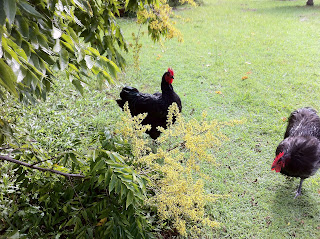
Everyone who meets my beautiful Australorp Rooster, Chop-Chop comments on how big he is. Some people tend to find his size intimidating, but he is such a tame, gentle baby despite his size.
I introduced him to my daughter, Hannah yesterday. The last time she saw him, Choppy and his hatch mates were only about 8 weeks old and quite a lot smaller than they are now.
Choppy, always being interested in something nice to eat, came running down to greet us when he heard our voices in the yard.
Tearing up to us at full pelt, I guess he was a bit of a formidable sight! Hannah squeaked in alarm and stepped backwards, holding out her hands to ward him off, and Chop Chop stopped in his tracks clucking his confusion at this strange reaction.
I encouraged Hannah (who is 23) not to be afraid and that Choppy is just a big sook.
After a few nervous moments observing him and being reassured that he would not attack her, Hannah fed him some wild corn, which he picked, delicately from the palm of her hand, amazing her with his gentleness.
He is a sweet natured boy and has never shown the slightest hint of aggression towards anyone.
Despite his formidable size, he truly is just a big old baby and I adore my gentle giant.
Showing posts with label sustainability. Show all posts
29 March 2012
12 March 2012
Rooster Boxes
I mentioned at the end of my previous post that my nextdoor neighbour had come over to my place on Saturday with an idea for a possible rooster box to put ChopChop our remaining rooster into at night time in an attempt to keep him quiet in the mornings. Not that Choppy crows all that much anyway, but I am interested in the idea of using a rooster box, both for now and for future roosters who may turn out to be just as dominant and noisy as ChopChop's brother, Boomer was.
The idea of a rooster night box, is to keep the bird in the dark until well past dawn and thus hopefully prevent him from crowing until a more reasonable time than say, 3am!
My neighbour came to ask me, initially, how to build the kind of box that I thought would work, but in the course of our discussion he had a brainwave. He hurried off back home to collect an item he had lying around in his garden shed to see if I thought it would be suitable.
The above picture is what he brought back. It is a collapsible canvas dog kennel for a small to medium dog, complete with a nice, soft cushion for the dog to sleep on. It is lying on its side in this image because it has a mesh bottom and we thought that would be good for airflow. The rooster could sleep inside this, with the cushion and some wood shavings underneath him for comfort and hygiene, and the mesh bottom could be faced toward the wall to allow air through without letting in too much light. I thought this was worth a try and R went back home to find something to use as a door for it.
The idea of a rooster night box, is to keep the bird in the dark until well past dawn and thus hopefully prevent him from crowing until a more reasonable time than say, 3am!
My neighbour came to ask me, initially, how to build the kind of box that I thought would work, but in the course of our discussion he had a brainwave. He hurried off back home to collect an item he had lying around in his garden shed to see if I thought it would be suitable.
The above picture is what he brought back. It is a collapsible canvas dog kennel for a small to medium dog, complete with a nice, soft cushion for the dog to sleep on. It is lying on its side in this image because it has a mesh bottom and we thought that would be good for airflow. The rooster could sleep inside this, with the cushion and some wood shavings underneath him for comfort and hygiene, and the mesh bottom could be faced toward the wall to allow air through without letting in too much light. I thought this was worth a try and R went back home to find something to use as a door for it.
The door is fashioned out of an old cargo pallet R had 'in the shed' as well.
R attached an aluminium bracket to the top of the wooden door.
The bracket neatly hooks over the metal framework and the bottom of the door
Pushes in flush against the front of the kennel.
The Rooster Box installed in the chicken coop ready for its occupant.
ChopChop checking out the new digs.
We have used this for three nights, so far, and it seems to work well, except for the second night when I had not quite blocked all light from getting into the box. Last night, I made a couple of tweaks to the coop area where the box is, and as far as I know, Choppy didn't crow at all. In fact, he has not crowed all day today. I wonder if he thinks being quiet means he won't need to go back into the box again?
So far, so good.
Next time: "Uh-oh, I'm broody again!"
Labels:
australorp,
chickens,
chooks,
city chicks,
country living,
hensington palace hens,
hobby farming,
housing,
husbandry,
keeping chickens,
pet care,
pets,
raising chickens,
sunshine coast,
sustainability
23 September 2011
23 September 2011
We have had a busy week in our garden again this week. Spring break
for Sandra, means she has wanted to get a few things done, both indoors
and outdoors while she has some time off from attending classes. She has
tidied her study and now it puts mine to shame! *blush*
In the garden, Sandra dug a new garden bed, but sadly, the place where it is located has very poor soil, so that has been a bit of a wasted effort. I don't know if we will just let it grow over with grass again, or try and build up the soil. We used the chickens to help with the work of digging, by setting up a temporary tractor for them using garden stakes and some netting we bought cheap from the reject shop. We draped an old piece of shadecloth over it. The end result was makeshift, but was sufficient just to keep them pnned there for the day while they scratched over the ground.


Maybe
the lack of digging and scratching by the hens should have alerted us
that this soil was pretty lacklustre. Oh well, live and learn.
So,
now we need to find an alternate location to plant some more veges and
try to build up this area's soil as our ultimate aim is to have the vege
garden close to the house so that it is easy to get fresh produce for
the kitchen.
Sandra
also created a compost bin from one of the plastic garbage cans we
bought from Bunnings with the gift vouchers I received for my birthday
in August. She cut the bottom out of the bin so we could then turn it
upside down to use as a compost bin. and the lid now sits nicely on the
'top' (what used to be the bottom) of the inverted bin. There are some
grass clippings in here already and next time the Bokashi is full, I
will put the contents into this bin with some soil so that it can break
down into compost.
The
chair standing behind the compost bin is to protect newly planted choko
vines which we have put in here to train them over the chicken coops
for shade for the hens in summer.
Of course, this compost bin may end up being a smelly, slimy failure so we have a backup plan in case that happens.
This
is your common, garden variety compost heap just grass clippings at the
moment, but I will soon be adding deep litter from our chicken coops to
this as I am about to clean out the roost and run and replace the
litter with fresh litter for the warmer months. I use a deep litter
system as it only requires cleaning about twice yearly. In between clean
outs I just add new litter on the top whenever the pens start to get a
bit smelly. The chickens keep it turned over with their scratching
around in the run. They can be encouraged to scratch more by tossing
some grain down on the floor once a week.
On
Wednesday afternoon, a courier delivered a dozen fertile eggs which I
had ordered for our broody hen, Bertha. I had been anxiously awaiting
their arrival and keeping close to the house whilst Sandra worked on
compost bins, heaps, and garden beds. We eagerly opened to package to
find that, sadly, two of the eggs got broken in transit. They were quite
crushed, but the other ten were in good condition. We placed them in
the bathroom on the counter to rest for twenty-four hours before putting
them under our hen.
I
put the fertile eggs under her about 6:30 last night. She is such a
patient hen and didn't fuss about me slipping 10 eggs under her. She
just soflty clucked: "buk-book-buk buk-book-buk?" as though gently welcoming each new egg. She's such a good chookie, I really hope these eggs hatch for her.
17 September 2011
Bokashi, Books and Broody hens
It was time to bury another bucket full of Bokashi today so I took it up to where I buried the last lot on August 29, almost a month ago! My how time flies! I was curious to know how well the last lot I buried had broken down and I remembered saying on my blog that I would let you all know how it went. If you recall I said in THIS POST That I gathered up windfall citrus to bury with the bucket full of citrus peels, vege scraps, eggshells, and other waste from the kitchen mixed with Effective Microoganisms to help it break down.
I started to dig where I had buried the last lot and was very surprised at how soft the ground here was. I turned over a spadeful of the most delicious smelling compost! It's kind of fruity and sweet smelling and very moist.
For the most part, the scraps and peels had broken down completely, although there were still some little bits of citrus mixed through.
| Citrus in the compost |
I think that the bits of citrus that had not broken down yet might actually be from the whole ones I put in that I picked up around the yard. Anything that had been cut into small pieces and processed in the bucket prior to burying was gone!
I am really very pleased with this.
The vege patch continues to thrive, despite the potting mix we planted it in being quite hydrophobic and not holding moisture very well.
We have Roma Tomatoes coming on nicely!
We actually put some soil on some of the veges, from the bokashi compost pit, to see if it helps at all with moisture retention. We won't be doing the 'no dig' gardening method again, though. It hasn't really saved us any work because of the time involved in trying to keep the roots moist.
I am reading a good book at the moment called Frugavore: How to grow your own, buy local, waste nothing, and eat well by Arabella Forge. I'm really enjoying it and will post a review once I have finished it. Sandra is reading Changing Habits, Changing Lives by Cindy O'Meara and I want to read that after she is done with it.
Broody Update: Bertha sat all day again, today. I think she may have
been up for some food and water early in the morning, but hadn't
stirred again all day. It was a very warm day and I was concerned about
her, so I went and tried to put some water on her beak to tempt her to
drink from a little bowl I had with me, she told me where to get off!
I left her alone after that, but when I took a wet mash up for the
other girls this afternoon, I offered some to her in her own little bowl
and she ate about 1/4 cupful. That is food and water mixed together
with some egg added so I am content that she won't starve or dehydrate.
I've left a small bowl of water and a little bit of mash next to her
nest for her as well. She must think this is the life. No egg laying, a
comfy secure box all to herself and room service laid on! 
Labels:
animal care,
australia,
backyard hens,
bokashi,
books,
broodiness,
chooks,
composting,
homelife,
permaculture,
reading,
self sufficiency,
slow compost,
sustainability,
vegetable garden,
vegetables
12 September 2011
Food for Thought
Yesterday, Sandra and I attended the Sunshine Coast Real Food
Festival. This kind of thing is one of the reasons that I really love
living on the Sunshine Coast! A lot of people in the region are very
much into sustainability, self-sufficiency and alternative therapies,
health and all of that sort of thing. Since living here, I have become
increasingly aware of the environment and carbon footprints and such.
I've been doing my best of late to reduce, reuse and recycle as well as
to lead a more self-sufficient lifestyle, so this festival was right up
my alley!
We went to three different presentations on nutrition and health, and gleaned a lot from them. Some of the stuff that people said was contradictory, but that was because one of them was into whole food, which also allows for cooked foods, while another was into raw foods, so it is necessary to sort out what works for us from those opposing views and go with that. There was so much to see and do, we spent hours just browsing around, looking at exhibits, flicking through books, chatting to exhibitors, watching demonstrations, and of course, sampling some of the fine food and produce on offer!
As always, I carried my trusty iPhone with it's camera with me, and snapped a few pics.
A litter of cute little piglets. They had just had some sunblock put on as they were getting a little bit sunburned.

A leghorn hen with her beautiful, fashionable hat. Just the thing for a sunny outing in the country!
This is an Australorp hen. My favourite breed! There is something about the eyes of these chickens that I find intriguing. I call them 'Spanish eyes' Don't know why they strike me as particularly Spanish, though.
We went to three different presentations on nutrition and health, and gleaned a lot from them. Some of the stuff that people said was contradictory, but that was because one of them was into whole food, which also allows for cooked foods, while another was into raw foods, so it is necessary to sort out what works for us from those opposing views and go with that. There was so much to see and do, we spent hours just browsing around, looking at exhibits, flicking through books, chatting to exhibitors, watching demonstrations, and of course, sampling some of the fine food and produce on offer!
As always, I carried my trusty iPhone with it's camera with me, and snapped a few pics.
A litter of cute little piglets. They had just had some sunblock put on as they were getting a little bit sunburned.

A leghorn hen with her beautiful, fashionable hat. Just the thing for a sunny outing in the country!
This is an Australorp hen. My favourite breed! There is something about the eyes of these chickens that I find intriguing. I call them 'Spanish eyes' Don't know why they strike me as particularly Spanish, though.
It was a wonderful day, and we brought home lots of new ideas, and information about food, nutrition and health.
09 September 2011
Making EM Culture!
The past few weeks, I have been conducting highly classified, secret business! I didn't say anything about it until now, because this was the first time I had tried this recipe and I didn't want to embarrass myself if I created a horrendous zombiefied lactobacilli based monster and unleashed horror upon the world.
Yes, I was trying to culture lactobacillus, amongst other organisms for my bokashi bucket. Being on a pension, I try to do everything as frugally as I can, and am slowly teaching myself never to buy what I can make for myself, so, following THIS RECIPE I decided to try and make my own EM (Effective Microorganism) innoculant for bokashi composting. I was a bit worried that all I would end up with, would be a sour, stinking mess, but nothing ventured, nothing gained.
A couple of weeks ago, when we were going to eat rice for dinner, I washed my rice and reserved the water, setting it in a large jar in a dark cupboard for 7 days.
It came out, looking something like this
Yes, I was trying to culture lactobacillus, amongst other organisms for my bokashi bucket. Being on a pension, I try to do everything as frugally as I can, and am slowly teaching myself never to buy what I can make for myself, so, following THIS RECIPE I decided to try and make my own EM (Effective Microorganism) innoculant for bokashi composting. I was a bit worried that all I would end up with, would be a sour, stinking mess, but nothing ventured, nothing gained.
A couple of weeks ago, when we were going to eat rice for dinner, I washed my rice and reserved the water, setting it in a large jar in a dark cupboard for 7 days.
It came out, looking something like this
So, first part, successful! Now I had to add 10 parts milk, to 1 part rice water. I measured out 100ml of the water, to which I added 1 litre of milk, and back into the cupboard it went for another week.
That part came out looking like this:
I admit, I expected this to smell revolting, even though the recipe said that it should just smell like yoghurt, and I was surprised when I took the lid off, to discover it did actually smell just like, well, yoghurt! So that was looking good! I then strained out the solids from the liquid and put the liquid into another bottle which I added half a teaspoon full of molasses to.
There was a little fluid left over after filling the new bottle, so I poured that onto some potted plants as it is meant to be good for the soil.
It looks a lot nicer in this, final state, and it should keep for about 6-12 months under refrigeration. It smelled sweet because of the molasses and if it ever smells sour, it will mean that it has gone rancid and should be discarded.
Oh, as for the milk curds?
Poor Bertha, she still doesn't understand about food and fences!
Subscribe to:
Posts (Atom)